
The text of this interview is provided by our partner Alliance of European Mayors
AI empowering cities is no longer news. It is here to stay, embedded in the systems that move people, power buildings, and shape everyday life. The real question facing local governments today is no longer if they should adopt AI, but how to do it in a way that is sovereign, safe, and aligned with the public good. This “how” opens a new era of choices: how we design our infrastructure, how we govern data, how we build talent, and how we choose partners who can support long-term, responsible deployment.
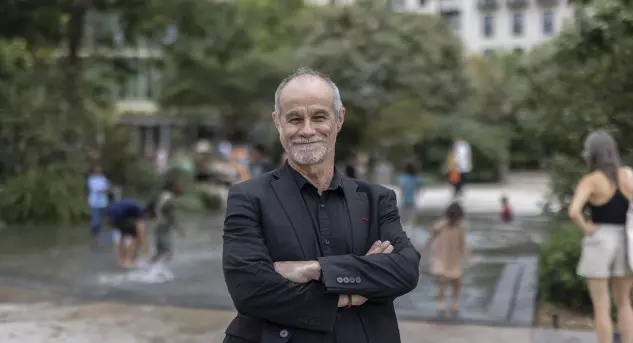
Among the architects of this shift is Charbel Aoun, a pivotal voice in the evolution of AI-enabled cities. As the Head of Smart Cities and Spaces for EMEA at NVIDIA, Mr Aoun operates at the intersection of public governance, advanced computing, and real-world deployment while helping governments move from ambition to capability. With 25 years of experience across Fortune 500 companies and high-growth technology ventures, he has shaped digital-transformation strategies long before AI became a policy priority.
For AI & the City, he offers a clear-eyed view of what local governments need to govern AI responsibly; how sovereignty, interoperability, and shared AI infrastructure will define Europe’s competitive future; and why the most successful municipalities are those investing not in tools, but in their own intelligence and talent.
This conversation marks an important moment in our series. It brings forward the thinking of one of the most influential leaders in the global AI ecosystem, at a time when European cities are seeking direction, capability, and partners who understand both the promise and the governance demands of this new era.
Building Capability in the AI Era
Leaders of the cities often say what they truly need in the AI transition is guidance, not just technology. From NVIDIA’s perspective, what kind of ecosystem or support structure helps cities adopt AI responsibly and confidently, especially when they are at very different levels of maturity? How would you describe your global approach to working with cities?
Cities don’t need more tools; they need a trusted partner who helps them de-risk the journey. Our approach at NVIDIA is simple: we help cities build AI capability, not AI dependency.
We bring a full ecosystem: system integrators, universities, sovereign cloud partners, startups, and solution providers that understand public-sector governance. We then marry guidance with technology:
- The Smart Cities AI Blueprint for strategic direction
- Omniverse for simulation and digital twins
- Metropolis for video intelligence and sensor fusion
- NIMs that let cities run AI wherever they want without lock-in
Above all, we believe sovereignty matters. Cities must own their compute, their data, and their intelligence.
Our philosophy is: Made in the city, for the city, by the city. We meet cities at their maturity level and help them scale in a responsible, governed, future-proof way.
AI is expected to boost city operational efficiency by up to 30% and cut service response times by 50% by 2030, yet only 18% of cities have an AI strategy. In your view, what is the single biggest barrier preventing cities from turning public data into public value at scale? How can industry-public sector partnerships help overcome that?
The biggest barrier isn’t a lack of technology; it’s fragmentation, talent gaps, and lack of interoperability. Cities have data spread across thousands of siloed systems. Without a unified infrastructure, even the best AI can’t scale.
This is where industry-public partnerships matter. We help cities consolidate data through the NVIDIA AI Factory architecture, deploy modular AI using NIMs, and unify sensor intelligence with Metropolis and VLM-powered reasoning.
When you combine city ownership with a trusted partner, fragmentation disappears, and public data becomes public value.
Scaling AI in Practice: From Mid-Sized Cities to Measurable Impact
With 54% of medium-sized European municipalities already experimenting with AI but only 4% achieving fully functional deployments, how do you empower leaders of mid-sized cities who may feel discouraged by limited budgets and digital maturity? What does an affordable, sustainable, non-vendor-lock-in partnership model look like in practice, the one that delivers measurable outcomes?
Mid-sized cities win when they focus on capability, not complexity.
We empower them to start small with high-value, low-cost use cases, such as traffic safety or energy optimization, powered by edge AI solutions like Jetson Thor and Metropolis.
To address limited budgets, we help them access capability affordably by establishing shared AI Factories and Centres of Excellence (COEs), effectively making AI Compute-as-a-Service (CaaS) available.
This model is fully open and sovereign: cities use NIMs and the interoperable CUDA ecosystem to run AI on-prem or in sovereign clouds, guaranteeing a future-proof investment with zero vendor lock-in.
What are the most promising use cases you are seeing today where AI is already delivering measurable citizen outcomes? And which cities across Europe do you consider early movers that are truly making the change?
The most exciting use cases are those with measurable outcomes that citizens feel immediately. We are seeing significant results in Traffic & Road Safety, where Metropolis and VLMs analyze dangerous behaviors, helping to reduce accidents by 20-40%. In Building & Energy Efficiency, Omniverse digital twins are helping cities cut energy use by 10-25% in public buildings.
Beyond these, AI detects hazards, optimizes waste logistics, and improves public safety resilience.
Across Europe, early movers include Smart Dublin (pioneering AI governance) and SNCF Gares & Connexions (advanced passenger flow management). Other proactive cities include Tampere, Lodz, and Palermo, cities that are demonstrating true leadership by building internal AI capability.
Talent, Physical AI, and Europe’s Path to Sovereign Intelligence
Education and workforce capacity are critical enablers of AI adoption. How is NVIDIA engaging with city governments and civic institutions to build the human-capacity side of “AI in the city”?
Talent development is one of our biggest investments in the public sector. We help cities upskill their workforce through the NVIDIA Deep Learning Institute and city-specific training labs, providing Omniverse and Metropolis certifications for civil servants and local integrators.
Crucially, we help cities establish Centres of Excellence (COEs) and build talent pipelines with universities, embedding AI, digital twins, and data science into local curricula.
This commitment to local growth is how you build Sovereign AI: by empowering people to use it confidently, responsibly, and sustainably.
Digital twins have become a familiar milestone for many cities, yet they represent only the first layer of a much larger shift toward Physical AI, where simulated environments evolve into intelligent, real-time systems that shape how cities operate. From your perspective, what will it take for cities to move beyond visual modelling and embrace this deeper, more transformative stage of AI-enabled urban management. How is NVIDIA helping them get there?
Moving from visual models to intelligent operations requires three foundational changes:
- A Unified, Real-Time Data Fabric: Connecting sensors, cameras, traffic systems, and buildings – all in real time.
- AI that Can Perceive, Reason, and Decide: Using Vision-Language Models (VLM), Cosmos Reason, and simulation in Omniverse, Physical AI turns digital twins into decision systems.
- An Operational AI Factory and Governance Layer: A shared compute foundation that delivers real-time insights across mobility, energy, and safety, coupled with the talent to run AI safely.
NVIDIA brings the full stack: from edge sensors to AI Factories that power Physical AI. We help cities move from ‘3D visualization’ to ‘real-time simulation’ to ‘AI-driven operations’.
Europe is accelerating its efforts to build sovereign AI capacity, from national compute infrastructures to emerging “AI-factory” scale facilities designed to keep strategic AI capabilities within EU borders. How does NVIDIA support this shift toward compute and data sovereignty, and what does a truly sovereign AI architecture for cities and public institutions look like in practice?
A truly sovereign architecture has four pillars of local control: Sovereign Compute (AI Factories in Europe), Sovereign Data (kept local & governed locally), Sovereign Models (tuned for local context via NIMs), and Sovereign Talent & Capability.
Our role is simple: to be the trusted technology partner that helps Europe build AI made in Europe, for Europe, by Europe, while remaining fully interoperable and fully under local control. We give Europe the tools to own its compute, its data, and its intelligence.