
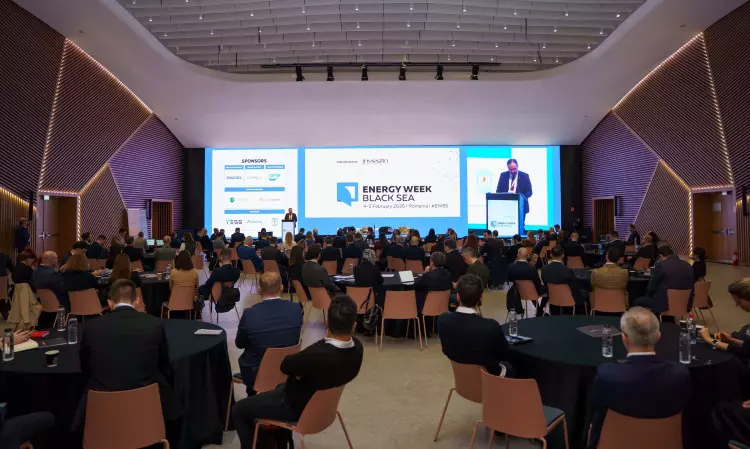
On 4–5 February, Energy Week Black Sea 2026 took place at the NORD Events Center in Bucharest, gathering policymakers, regulators, utilities, developers, financiers and technology companies from across the Black Sea region and wider European markets. Organised by Invest In Network, the sixth edition once again positioned itself as a regional meeting point for those working at the intersection of energy policy, infrastructure and capital.
The conference marked the continuation of a format that combines high-level debate with practical engagement. Alongside the plenary sessions, participants used Invest In Network’s InNet Connect platform to pre-schedule structured B2B meetings, allowing discussions to move beyond general statements toward concrete partnerships and transactions.
This year’s agenda reflected the pressures shaping the region: accelerating renewable deployment, reinforcing grids and cross-border interconnections, securing financing in volatile conditions and responding to the growing electricity demand driven by digital infrastructure.
A region under pressure
The opening interventions grounded the discussion in current realities. Ukraine’s Ambassador to Romania, Ihor Prokopchuk, referred to the strain on Ukraine’s energy infrastructure caused by the ongoing war and repeated attacks on critical facilities. Without alarmism, he emphasized the interconnected nature of regional systems and the need for coordinated reconstruction, modernization and protection of infrastructure across borders.
Regional interdependence was also central to the remarks of Inga Pkhaladze, Deputy Minister of Economy and Sustainable Development of Georgia. She highlighted Georgia’s strategic position along key energy corridors and pointed to initiatives such as the Black Sea Submarine Cable and the Green Energy Corridor as practical mechanisms for deeper integration with European markets.
Moldova’s Minister of Energy, Dorin Junghietu, focused on system resilience. He stressed the importance of storage capacity, expanded interconnections with Romania and regulatory predictability as foundations for investor confidence. Specific high-voltage projects were mentioned as tangible steps toward strengthening Moldova’s energy stability and regional integration.
Grids before growth
If one theme consistently resurfaced, it was infrastructure. During the “Grids & Cross-Border Interconnectors” panel, speakers representing transmission, trading and distribution segments agreed that renewable expansion cannot move faster than network development. Modern, flexible grids and streamlined permitting processes were described as essential conditions for integrating new capacity.
The conversation went beyond cables and substations. Governance clarity and cross-border coordination were presented as equally important. Renewable targets, participants suggested, remain theoretical unless supported by institutions capable of delivering infrastructure on time.
Offshore wind was approached with similar pragmatism. Romania’s potential in the Black Sea was described as significant, yet regulatory complexity, geopolitical risk and infrastructure gaps were acknowledged as real constraints. Turning technical potential into bankable projects will require coordinated regional action and long-term investment discipline.
Digital demand and connectivity
A newer dimension of the energy transition emerged in the session on data centres and AI. As digital infrastructure expands, so does electricity consumption. Participants discussed how large-scale data centres demand reliability, flexibility and clean supply, pushing planners to rethink generation capacity, storage solutions and grid design.

The Black Sea Submarine Cable session brought the discussion back to connectivity. Conceived as a bidirectional link between Romania and Georgia, the project aims to enable electricity exchange between the South Caucasus and the European Union. While technically and financially complex, it was described as strategically relevant in the broader context of European decarbonisation and energy diversification.
Across discussions on hydrogen, financing and risk mitigation, one underlying conclusion emerged. The Black Sea energy transition is less a question of ambition than of delivery. Infrastructure investment, regulatory stability and sustained cross-border cooperation will determine whether the region can translate momentum into durable transformation.

Energy Week Black Sea 2026 reflected that shift. The tone was measured, often technical, occasionally cautious. Yet beneath the detail was a shared recognition: the transition is underway, but its success will depend on the pace and coordination of infrastructure development across the region.
Read more about conferences and exhibitions here